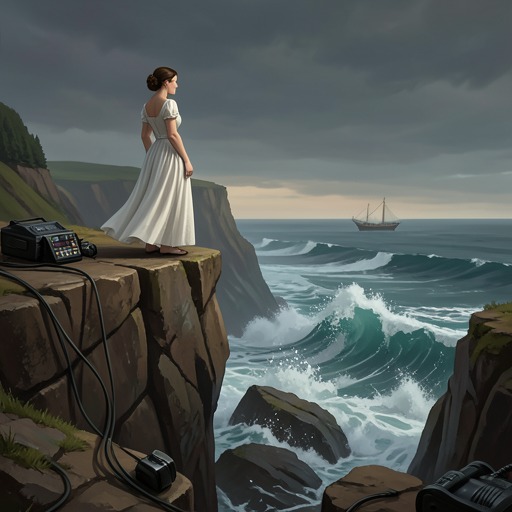
Gloomy Sunday
The HummingbirdGloomy Sunday is a song whose reputation for unbearable sadness gives it a pivotal role in the depiction of Irene’s crisis. In the Carrera household, its repeated playback is not merely a musical preference: the song functions as a warning that goes unheard, while its history outside the novel explains why the choice carries such foreboding.
Composition and Reputation
Known in Hungarian as Szomorú vasárnap, the song was written in Hungary in the 1930s, with lyrics by László Jávor and music by the self-taught pianist Rezső Seress. Pál Kalmár made the first recording in 1935, and the song quickly achieved international success. An English-language version by lyricist Sam Lewis, recorded in 1936, helped establish it as a jazz standard.
Alongside its popularity spread the legend that the song’s inconsolable sadness had led many listeners to suicide. Stories attached names and circumstances of death to the claim, and the song acquired the worldwide epithet “the Hungarian song of suicides.” Its fame prompted censorship and restrictions on broadcasting. The book presents this legend as a cultural history surrounding the song, not as proof that the music caused the deaths attributed to it.
Versions and Attempts to Soften the Song
A 1941 verse added to Billie Holiday’s version attempted to recast the preceding sorrow as a dream. Its explanation—that the speaker had only been dreaming—offered a way to retreat from the song’s apparent finality. The novel’s account of Irene’s listening emphasizes that the Lydia Lunch recording she chose omits this reassuring addition: the sadness remains without the qualification that it was only a dream.
The song also had an Italian version, Sad Sunday, with lyrics by Nino Rastelli. Singers who performed it over the years included Norma Bruni, Carlastella, Myriam Ferretti, Giovanni Vallarino, and, notably, Nilla Pizzi in 1952. Unlike the softened English version, the Italian adaptation did not try to blunt the song’s sadness or make its connection between love and suicidal agony less explicit.
The song’s afterlife continued across popular culture. The book notes versions by Ricky Nelson, Marianne Faithfull, Elvis Costello, Sinéad O’Connor, and Björk, among many others. It also mentions The Kovak Box, a 2006 Anglo-Spanish film in which microchips encourage people to commit suicide when they hear the song over the telephone. The film extends the song’s sinister reputation into fiction, turning its association with suicide into an explicit plot device.
Irene’s Repeated Listening
In the novel’s account of Irene, Gloomy Sunday is the most consequential item in a pattern of visible distress. She listens to Lydia Lunch’s punk version on a cassette recorded on both sides, which has been playing on repeat for days in the red Walkman her brothers gave her for Christmas. The cassette’s repetition makes the song an ongoing presence in the house rather than a passing choice.
The narration treats that presence as an alarm. Irene is exhausted, but the people around her do not recognize the warning in her appearance or in what she listens to. Her mother, Letizia, also fails to see her distress. The song’s public reputation makes its recurrence legible to the reader as a sign of imminent danger even as the family remains inattentive.
That contrast gives the song a precise narrative function: it carries information about Irene’s condition that her relatives do not perceive. Its repeated playback is not presented as the cause of her crisis; instead, it marks the crisis that others have failed to notice. The family’s inattention and the song’s ominous associations converge as the household empties and events move toward Irene’s death.
Death and Historical Echo
The novel’s scene of Irene’s death places the song within a wider pattern of separate family experiences unfolding along the same coast. While other members of the Carrera family experience moments of happiness, Irene’s body is eventually found by the sea. The contrast makes the song’s role as an unheard warning all the more stark: the alarm has sounded for days, but recognition comes too late.
The book’s historical notes also record that Seress died by suicide in 1968, jumping from a window of his home in Budapest. This biographical fact echoes the song’s grim reputation, but the novel keeps the distinction between history and legend: the legend attributes numerous deaths to the song, whereas Seress’s death is reported as a separate fact. Together, the account of Irene, the song’s contested reputation, and the composer’s death make Gloomy Sunday a point where cultural myth and a particular family tragedy meet without becoming identical.